
Sheet music looks like a foreign language the first time you see it. Black dots scattered across horizontal lines, strange symbols, numbers stacked at the beginning — it can feel overwhelming. But here's the thing: it all follows simple, logical rules. Once you understand those rules, you can read music written by anyone, for any instrument, from any era.
This guide walks you through everything you need to start reading sheet music — from the very first line on the page to the symbols that tell you how loud or soft to play. No prior knowledge required. Just a willingness to learn a new skill that will serve you for the rest of your musical life.
The Staff — Five Lines, Four Spaces
All of Western music notation is built on a simple framework called the staff (also called a stave). It consists of five horizontal lines with four spaces between them. Notes sit either on the lines or in the spaces, and their vertical position tells you the pitch — higher on the staff means a higher-sounding note.
Notes on the Treble Clef Staff
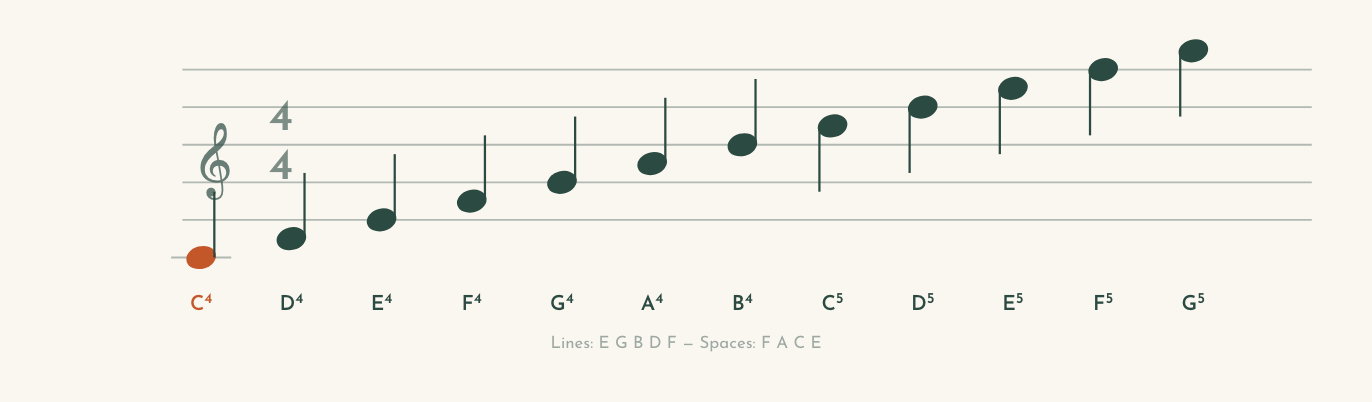
Think of the staff as a ladder for sound. The bottom of the staff is low pitch, the top is high pitch. Each line and each space represents a specific note, but which note depends on the clef at the beginning of the staff.
Music is divided into short sections called measures (or bars), separated by vertical lines called bar lines. At the end of a piece, you'll see a double bar line — two vertical lines, with the second one thicker — signaling the end.
Clefs — Treble and Bass
A clef is the symbol at the beginning of every staff. It tells you which notes the lines and spaces represent. The two most common clefs are treble and bass.
The treble clef (also called the G clef because its curl wraps around the G line) is used for higher-pitched instruments and voices: violin, flute, clarinet, trumpet, guitar, and the right hand of piano. Most popular music is written in treble clef.
The bass clef (also called the F clef because its two dots surround the F line) is used for lower-pitched instruments: cello, bass guitar, trombone, tuba, and the left hand of piano.
Piano players read both clefs at once. The treble staff (right hand) and bass staff (left hand) are connected by a brace on the left side, forming what's called the grand staff. A single note — middle C — sits on a small line between the two staves, acting as the bridge between them.
Note Names on the Staff
Music uses only seven letter names: A, B, C, D, E, F, G. After G, the sequence repeats starting at A again, one octave higher. The trick is knowing which letter belongs to which line or space in each clef.
Treble Clef Notes
The notes on the lines of the treble clef, from bottom to top, are: E, G, B, D, F. The classic mnemonic is "Every Good Boy Does Fine."
The notes in the spaces, from bottom to top, spell out the word FACE: F, A, C, E. That one is easy to remember.
Notes on the Treble Clef Staff
Bass Clef Notes
The notes on the lines of the bass clef, from bottom to top, are: G, B, D, F, A. A common mnemonic is "Good Boys Do Fine Always."
The notes in the spaces, from bottom to top, are: A, C, E, G. You can remember this as "All Cows Eat Grass."
Don't try to memorize everything at once. Start with one clef — whichever one your instrument uses — and learn those note positions until they become automatic. The other clef can wait.
Ledger Lines
The staff only has five lines, but music needs more range than that. When a note is too high or too low to fit on the staff, short extra lines called ledger lines are added above or below.
The most important ledger-line note is middle C. In treble clef, middle C sits on one ledger line below the staff. In bass clef, it sits on one ledger line above the staff. It's the same pitch in both cases — the two clefs simply approach it from different directions.
You'll encounter ledger lines often, but rarely more than three or four above or below the staff. If a passage goes much higher or lower than that, the composer usually switches to a different clef or uses an "8va" marking to indicate playing an octave higher or lower.
Note Values — How Long to Hold
Pitch tells you which note to play. Note values tell you how long to hold it. The shape of the note — its head, stem, and flags — indicates its duration relative to the beat.
- Whole note — An open oval with no stem. Lasts four beats in 4/4 time. It fills an entire measure.
- Half note — An open oval with a stem. Lasts two beats. Two of these fill a measure in 4/4.
- Quarter note — A filled-in oval with a stem. Lasts one beat. This is the most common note value and the one you'll see most often.
- Eighth note — A filled-in oval with a stem and one flag (or a beam connecting it to the next eighth note). Lasts half a beat. Two eighth notes equal one quarter note.
- Sixteenth note — A filled-in oval with a stem and two flags (or double beam). Lasts a quarter of a beat. Four sixteenth notes equal one quarter note.
A dotted note has a small dot after it, which adds half of the note's original value. A dotted half note, for example, lasts three beats instead of two (2 + 1 = 3). A dotted quarter note lasts one and a half beats.
A tie is a curved line connecting two notes of the same pitch. You play the first note and hold it for the combined duration of both. Ties let you sustain notes across bar lines or create rhythms that don't fit neatly into standard note values.
Rests — The Sound of Silence
Music isn't just about sound — silence matters too. Every note value has a corresponding rest symbol that tells you to stay silent for that duration.
- Whole rest — A small filled rectangle hanging below the fourth line. Lasts four beats (or fills whatever remains of a measure).
- Half rest — A small filled rectangle sitting on the third line. Lasts two beats.
- Quarter rest — A zigzag or squiggly vertical symbol. Lasts one beat.
- Eighth rest — Looks like a small "7" with a dot. Lasts half a beat.
- Sixteenth rest — Similar to an eighth rest but with two flags. Lasts a quarter of a beat.
Beginning musicians often rush through rests. Don't. Rests are just as important as notes — they give the music shape and space to breathe. Count them out the same way you count notes.
Time Signatures — Counting Beats
At the beginning of a piece (right after the clef and key signature), you'll see two numbers stacked on top of each other. This is the time signature, and it tells you how the music is organized into beats and measures.
The top number tells you how many beats are in each measure. The bottom number tells you which note value gets one beat.
- 4/4 — Four quarter-note beats per measure. This is the most common time signature in Western music, often marked with a large "C" (for "common time").
- 3/4 — Three quarter-note beats per measure. This is the time signature for waltzes and many folk songs. Count: ONE-two-three, ONE-two-three.
- 6/8 — Six eighth-note beats per measure, usually felt as two groups of three. Common in jigs, marches, and some ballads. Count: ONE-two-three-FOUR-five-six.
The time signature doesn't change the pitch of any notes — it only affects how you count and where the strong beats fall. When you tap your foot along to music, you're feeling the time signature. A waltz in 3/4 has a different feel from a rock song in 4/4, even if they use the same notes.
Key Signatures — Sharps and Flats
Right after the clef, you may see one or more sharp (#) or flat (b) symbols clustered at the beginning of the staff. This is the key signature, and it tells you which notes are consistently raised or lowered throughout the piece.
A sharp raises a note by a half step. A flat lowers it by a half step. Instead of writing a sharp or flat next to every affected note, the composer puts them in the key signature once, and they apply to every occurrence of that note in the piece.
For example, if you see one sharp (F#) in the key signature, every F in the piece is played as F-sharp unless marked otherwise with a natural sign. If you see two flats (Bb and Eb), every B and E are flatted.
Key signatures follow a predictable pattern related to the circle of fifths. Sharps are added in the order F, C, G, D, A, E, B. Flats are added in the reverse order: B, E, A, D, G, C, F. Learning this pattern helps you quickly identify what key you're playing in.
A natural sign cancels a sharp or flat from the key signature for the rest of that measure. It's a small square with vertical lines extending from opposite corners.
Dynamics and Articulation
Notes and rhythms are only part of the story. Sheet music also tells you how to play — how loud, how soft, and how each note should connect to the next. These markings bring music to life.
Dynamics — Volume
- pp (pianissimo) — Very soft
- p (piano) — Soft
- mp (mezzo piano) — Moderately soft
- mf (mezzo forte) — Moderately loud
- f (forte) — Loud
- ff (fortissimo) — Very loud
A crescendo (gradually getting louder) is shown as an opening hairpin angle, like <. A decrescendo or diminuendo (getting softer) is the reverse, like >. These markings appear below the staff and span across the notes they affect.
Articulation — How to Play Each Note
- Staccato — A dot above or below the note. Play it short and detached, like a quick tap.
- Legato — A curved line (slur) connecting two or more notes. Play them smoothly, connected without a gap.
- Accent — A > symbol above the note. Play it with extra emphasis.
- Fermata — A dot under a curved line above the note. Hold the note longer than its written value — how much longer is up to the performer.
You won't need to memorize all these markings before you start reading music. Learn them as you encounter them. The important thing now is to know they exist so you're not confused when you see them on the page.
Practice on blank manuscript paper
Generate printable staff paper with treble, bass, grand staff, or tab lines. Choose your clef, paper size, and download PDF.
Generate Blank Staff PaperPractice Reading — Getting Started
Knowing the rules is one thing. Reading music fluently is another. Like reading text, it takes practice until the symbols become automatic. Here are concrete ways to build your reading skills.
- Start with note names only. Before adding rhythm, just practice naming the notes on a staff. Look at a piece of sheet music and say each note aloud: "E, G, A, F, D..." Speed comes with repetition.
- Add rhythm separately. Clap or tap the rhythms of a piece without worrying about pitch. Count out loud: "1 and 2 and 3 and 4 and." This builds your rhythmic independence.
- Combine slowly. Once note names and rhythms feel comfortable on their own, combine them at a very slow tempo. Use a metronome and don't speed up until it feels easy.
- Read new music every day. Sight-reading improves only when you read unfamiliar material. Don't keep re-reading the same piece. Find simple pieces and read through them once, then move on.
- Write notes by hand. Writing reinforces recognition. Print blank manuscript paper with your preferred clef and staff layout and practice writing note names on the lines and spaces.
- Use flashcards. Make cards with a note drawn on a staff on one side and the note name on the other. Quiz yourself until you can name any note in under two seconds.
Once note reading starts to feel natural, try writing your own sheet music with the Sheet Music Editor. Writing music deepens your understanding of how notation works, and there's nothing quite like seeing your own musical ideas on the page.
And when you're ready to collect your favorite pieces, gather your songs into a printed songbook you can put on your music stand and keep for years.
Frequently Asked Questions
How long does it take to learn to read sheet music?
Most people can learn the basics — note names, simple rhythms, and a single clef — in a few weeks of regular practice. Reading fluently at sight takes longer, usually several months to a year depending on how often you practice. The key is consistency: ten minutes a day beats an hour once a week.
Do I need to read music to play an instrument?
No. Many excellent musicians play by ear, use chord charts, or learn from tabs. But reading music opens doors — you can learn any piece without a recording, communicate with other musicians precisely, and access centuries of written music. It's a skill worth having even if you don't use it every day.
What's the difference between treble clef and bass clef?
The treble clef (G clef) marks higher-pitched notes and is used by instruments like violin, flute, guitar, and the right hand of piano. The bass clef (F clef) marks lower-pitched notes and is used by instruments like cello, bass guitar, trombone, and the left hand of piano. The note names on the lines and spaces are different for each clef.
What does the time signature tell me?
The top number tells you how many beats are in each measure. The bottom number tells you which note value gets one beat. So 4/4 means four quarter-note beats per measure, 3/4 means three quarter-note beats (like a waltz), and 6/8 means six eighth-note beats, usually felt as two groups of three.
How do I practice sight-reading?
Start with simple pieces well below your playing level. Read through them without stopping — even if you make mistakes, keep going to build the habit of looking ahead. Use a metronome at a slow tempo. Practice a new piece every day rather than re-reading the same one. Blank manuscript paper is also useful for writing out notes to reinforce what you've learned.
Réponses
Chargement…
Related Articles
Understanding Major and Minor Scales — A Practical Guide for Musicians
Scales are the foundation of melody, harmony, and improvisation. This guide breaks down major and minor scales with clear diagrams, audio examples, and practical exercises you can print.
Free Printable Blank Sheet Music Paper (Staff Paper)
Blank manuscript paper shouldn't be one-size-fits-all. Here's how to generate free printable staff paper with custom staves, clefs, and bar lines, and how to add pages to a lesson or practice book.
How Chords Are Built — Triads, Sevenths, and Beyond
Every chord is built from a scale using a simple stacking pattern. Learn how triads, seventh chords, and extensions work — with diagrams for guitar, piano, and ukulele.