
Every chord you've ever played — from an open G on guitar to a jazzy Dm9 on piano — is built from the same simple principle: stack notes from a scale in thirds. Once you understand how that stacking works, you stop memorizing chord shapes and start understanding why chords sound the way they do.
This guide walks through chord construction from the ground up: intervals, triads, seventh chords, diatonic harmony, and extensions. Whether you play guitar, piano, ukulele, or any other instrument, the theory is the same.
Chords Start with Scales
Before you can build a chord, you need a scale. If you're not comfortable with major and minor scales yet, take a look at our practical guide to scales first.
Here's the short version: a major scale is a sequence of seven notes following a specific pattern of whole steps (W) and half steps (H):
W — W — H — W — W — W — H
In the key of C, that gives you: C — D — E — F — G — A — B. No sharps, no flats. Every other major scale follows the same pattern but starts on a different note.
Chords are built by picking notes from this scale — not consecutive notes, but every other note. That “skip one” pattern creates intervals called thirds, which are the foundation of Western harmony.
Intervals — The Building Blocks
An interval is the distance between two notes. For chord construction, you only need to know two types of thirds:
- Major third — 4 semitones (2 whole steps). Example: C to E.
- Minor third — 3 semitones (1.5 whole steps). Example: C to Eb.
A semitone is the smallest step on your instrument — one fret on guitar, one key on piano (including black keys). Two semitones make a whole step.
You also need to know about the fifth: 7 semitones above the root. This interval is called a “perfect fifth” and it gives chords their stability. The combination of thirds and fifths is what makes a chord sound like a chord rather than random notes.
Building a C Major Triad
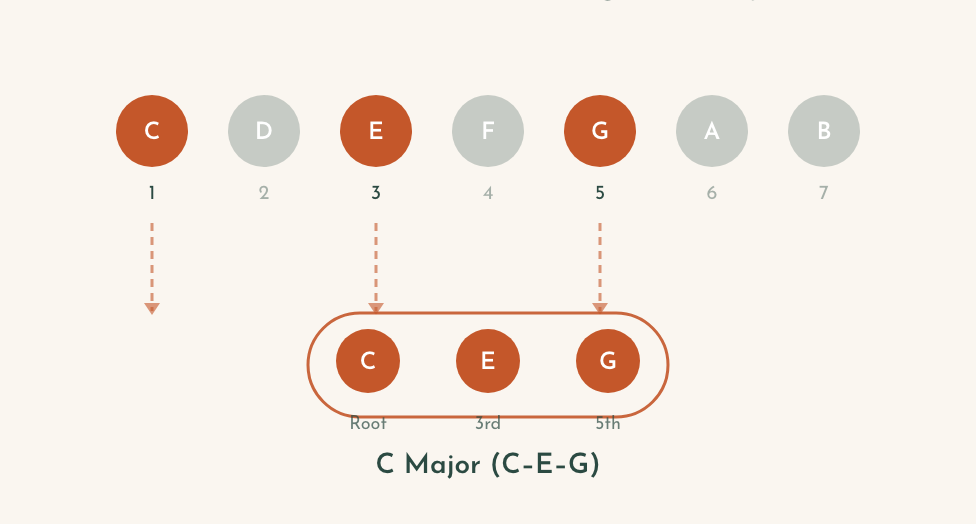
Triads — Your First Chords
A triad is a three-note chord built by stacking two thirds. There are four types, and each has a distinct sound:
Major Triad (1 — 3 — 5)
Stack a major third, then a minor third on top. Formula: root, major third, perfect fifth.
- C major: C — E — G
- G major: G — B — D
- D major: D — F# — A
Major triads sound bright, stable, and resolved. They're the “happy” chords — though that's an oversimplification. Context matters more than the chord alone.
Minor Triad (1 — b3 — 5)
Stack a minor third, then a major third on top. Formula: root, minor third, perfect fifth.
- C minor: C — Eb — G
- A minor: A — C — E
- E minor: E — G — B
Minor triads sound darker and more introspective. The only difference from a major triad is that the third is lowered by one semitone — one fret, one key. That single note changes the entire character.
Diminished Triad (1 — b3 — b5)
Stack two minor thirds. Formula: root, minor third, diminished fifth.
- B diminished: B — D — F
- C diminished: C — Eb — Gb
Diminished triads sound tense and unstable. They want to resolve — to move somewhere else. You'll hear them as passing chords or as the naturally occurring vii° chord in a major key.
Augmented Triad (1 — 3 — #5)
Stack two major thirds. Formula: root, major third, augmented fifth.
- C augmented: C — E — G#
- G augmented: G — B — D#
Augmented triads sound mysterious and suspended — like something is about to happen. They're less common than major and minor triads but show up in jazz, film scores, and Beatles songs.
Building a C Major Triad
Seventh Chords
Take any triad and stack one more third on top. Now you have a four-note chord — a seventh chord. The extra note adds color and tension. There are five common types:
Major 7th — Cmaj7 (1 — 3 — 5 — 7)
A major triad plus a major seventh (11 semitones above the root). Sounds warm, lush, and dreamy. Think of the opening chord of “Don't Know Why” by Norah Jones.
- Cmaj7: C — E — G — B
- Fmaj7: F — A — C — E
Dominant 7th — C7 (1 — 3 — 5 — b7)
A major triad plus a minor seventh (10 semitones above the root). This is the chord that wants to resolve — it's the engine of the V-I cadence that drives Western music. Blues, rock, and jazz are built on dominant sevenths.
- C7: C — E — G — Bb
- G7: G — B — D — F
Minor 7th — Cm7 (1 — b3 — 5 — b7)
A minor triad plus a minor seventh. Softer and more relaxed than a plain minor chord. Essential in jazz, R&B, and neo-soul.
- Cm7: C — Eb — G — Bb
- Am7: A — C — E — G
Half-Diminished — Cm7b5 (1 — b3 — b5 — b7)
A diminished triad plus a minor seventh. Also written as Cø. Less harsh than a fully diminished chord, with a bittersweet quality. It's the ii chord in minor keys and shows up constantly in jazz standards.
- Bm7b5: B — D — F — A
Fully Diminished 7th — Cdim7 (1 — b3 — b5 — bb7)
A diminished triad plus a diminished seventh (9 semitones — enharmonically a major sixth). All intervals are equal minor thirds, which means every inversion of a dim7 chord is another dim7 chord. Dramatic, theatrical, and surprisingly versatile.
- Cdim7: C — Eb — Gb — Bbb (A)
Diatonic Chords — Harmony from One Scale
Here's where it all comes together. Take a major scale and build a triad on every degree — using only notes from that scale. You get seven chords, and their qualities follow the same pattern in every key:
- I — Major (C)
- ii — minor (Dm)
- iii — minor (Em)
- IV — Major (F)
- V — Major (G)
- vi — minor (Am)
- vii° — diminished (Bdim)
Roman numerals are the universal language for this: uppercase for major, lowercase for minor, ° for diminished. When someone says “play a I-IV-V in G,” they mean G — C — D. When they say “it's a ii-V-I in C,” they mean Dm — G — C.
This system means you only need to learn chord relationships once. The pattern holds in every key. The circle of fifths helps you find these chords quickly in any key.
If you extend diatonic chords to four notes (seventh chords), the pattern becomes: Imaj7 — ii7 — iii7 — IVmaj7 — V7 — vi7 — viiø7. Notice that the V chord is the only dominant seventh — that's why it pulls so strongly back to the I.
Build a chord reference for your instrument
Pick from 130+ chord diagrams for guitar, piano, ukulele, bass, mandolin, and banjo. Arrange on a page, download PDF.
Open the Chord Sheet BuilderExtensions — 9ths, 11ths, and 13ths
Keep stacking thirds beyond the seventh and you get extensions. These add richness and complexity — they're the colors that make jazz and soul harmony so expressive.
- 9th — the note a major second above the octave (same note as the 2nd, but an octave higher). A C9 chord contains C — E — G — Bb — D.
- 11th — the note a perfect fourth above the octave (same as the 4th). Often played without the third to avoid clashing. A C11 chord contains C — E — G — Bb — D — F.
- 13th — the note a major sixth above the octave (same as the 6th). A C13 chord contains C — E — G — Bb — D — F — A. That's all seven notes of the scale — though in practice, players leave some out.
In practice, you don't need to play all the notes. Guitarists especially will drop the fifth or the root and let the bass player handle those. The extensions that matter most are the ones that define the chord's flavor: the third, seventh, and the extension itself.
Common Chord Progressions
Now that you know how chords are built, here are three progressions you'll hear everywhere. Understanding them as Roman numerals means you can play them in any key instantly.
I — IV — V (The Three-Chord Song)
The foundation of rock, country, blues, and folk. In C: C — F — G. In G: G — C — D. Simple, strong, and universally satisfying. Add dominant sevenths (I7 — IV7 — V7) and you have a 12-bar blues.
I — V — vi — IV (The Pop Progression)
The most-used progression in modern pop music. In C: C — G — Am — F. It works because the vi chord (relative minor) adds emotional depth without leaving the key. Thousands of hits use this exact sequence.
ii — V — I (The Jazz Cadence)
The backbone of jazz harmony. In C: Dm7 — G7 — Cmaj7. The ii chord sets up tension, the V chord increases it, and the I chord resolves it. Learn to spot ii-V-I patterns and you can navigate most jazz standards.
These progressions are starting points. Once you can hear them, you'll start noticing substitutions, borrowed chords, and modulations in the music you already know. See how these chords look on a fretboard diagram to connect the theory to your instrument.
Practice: Building Chords Yourself
Theory sticks when you apply it. Here are five exercises to internalize chord construction:
- Spell triads from any root. Pick a random note — say, Eb. Spell the major triad (Eb — G — Bb), minor triad (Eb — Gb — Bb), diminished (Eb — Gb — Bbb), and augmented (Eb — G — B). Do this daily with different roots until it's automatic.
- Build diatonic chords in all 12 keys. Write out the seven diatonic triads for C major, then G major, then D major — keep going around the circle of fifths. You'll notice the same chords reappearing in different keys.
- Add sevenths to everything. Take any triad you know and figure out what seventh to add. Is it a major seventh or a minor seventh? Play both versions and hear the difference.
- Analyze songs you know. Take a song you can already play and write out the chords as Roman numerals. Most pop and rock songs use only three or four of the seven diatonic chords.
- Build a chord reference sheet. Build a chord reference sheet with diagrams for your instrument — seeing the shapes alongside the formulas connects theory to muscle memory.
Create a printable songbook with chord charts for your songs so you can practice these progressions with real music in front of you.
Frequently Asked Questions
What's the difference between a chord and a scale?
A scale is a sequence of notes played one at a time — it's a melodic tool. A chord is three or more notes from that scale played at the same time — it's a harmonic tool. Scales give you the raw material; chords are what you build from it.
Why are some chords major and others minor?
It comes down to the third. A major chord has a major third (4 semitones above the root), which sounds bright and resolved. A minor chord has a minor third (3 semitones above the root), which sounds darker and more introspective. Same root, same fifth — just one note different.
What does 'diminished' mean?
A diminished chord has both a minor third and a flattened fifth, making the interval between root and fifth smaller (diminished) compared to a normal chord. It creates a tense, unstable sound that wants to resolve to another chord. You'll hear it most often as the vii° chord in a major key.
How do I know which chords go together?
Build diatonic chords from a single major scale — the seven chords you get (I, ii, iii, IV, V, vi, vii°) all work together naturally. In the key of C, that gives you C, Dm, Em, F, G, Am, and Bdim. Most popular songs use only three or four of these chords.
What are slash chords?
A slash chord tells you to play a specific bass note under a chord. For example, C/E means a C major chord with E in the bass. The note after the slash isn't part of the chord formula — it's just the lowest note. Slash chords create smooth bass lines between chords and add variety to simple progressions.
Antworten
Laden…
Related Articles
Understanding Major and Minor Scales — A Practical Guide for Musicians
Scales are the foundation of melody, harmony, and improvisation. This guide breaks down major and minor scales with clear diagrams, audio examples, and practical exercises you can print.
The Circle of Fifths Explained — What It Is and How to Use It
The circle of fifths shows how all 12 keys relate to each other. Learn to read it, use it to find key signatures, transpose songs, and build chord progressions.
Chord Sheet Builder: Printable Chord Reference for Any Instrument
Use the Chord Sheet Builder to create printable chord diagrams for guitar, ukulele, piano, bass, mandolin, and banjo. 130+ diagrams or draw your own, download PDF — free, no account needed.