
If you've ever played all the white keys on a piano starting from D instead of C, you've already played a mode. It sounded different — darker, jazzier — even though you used the exact same notes. That shift in character is what modes are all about.
Modes have a reputation for being confusing, but the concept is straightforward once you see the pattern. This guide walks through all seven modes of the major scale, explains what makes each one unique, and shows you how to put them to work in your playing.
What Are Modes?
A mode is what you get when you take a major scale and start it from a different note. The C major scale has seven notes: C, D, E, F, G, A, B. If you play those same seven notes but start on D (D, E, F, G, A, B, C), you get D Dorian. Start on E, and you get E Phrygian. Same notes, different starting point, completely different sound.
Each starting point creates a different pattern of whole steps and half steps. That pattern is what gives each mode its distinct character. The major scale itself is a mode too — it's called Ionian. So when people say “the major scale,” they're really saying “Ionian mode.”
There are seven notes in the major scale, so there are seven modes. Each one starts on a different degree and produces a different mood — from bright and happy to dark and tense.
The Seven Modes of C Major
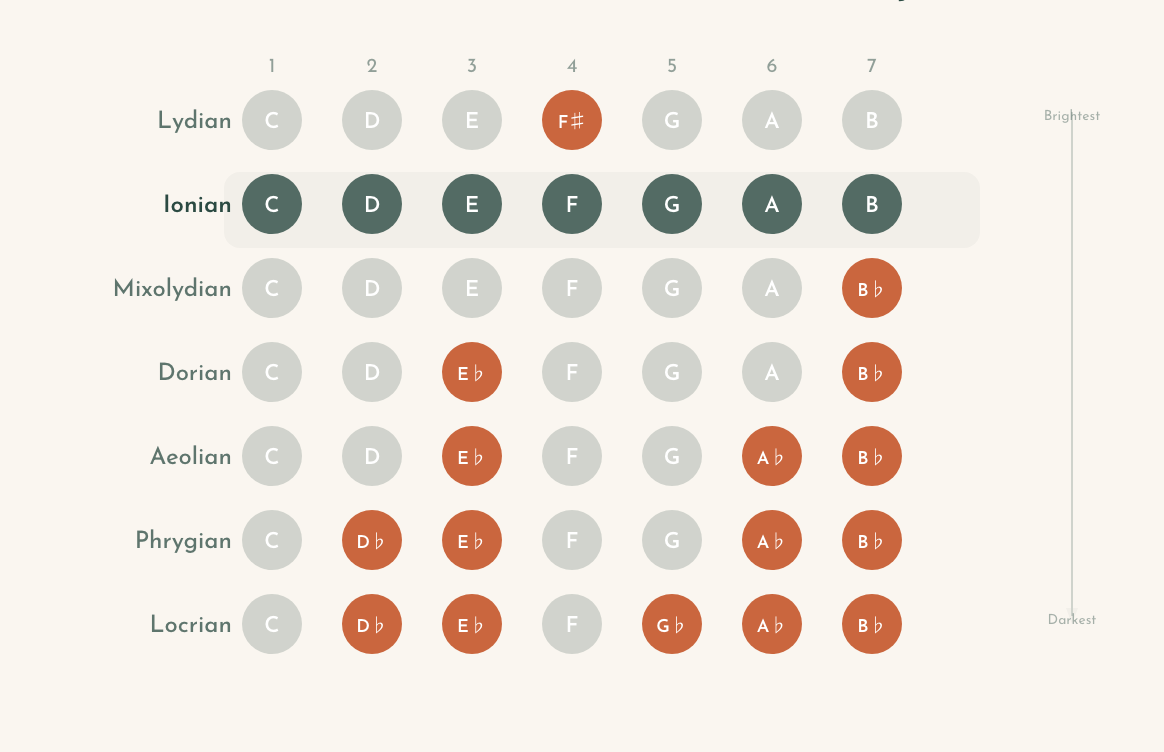
The Seven Modes
Here are all seven modes in order, each starting on the next degree of the major scale. The formulas show how each mode relates to a standard major scale (Ionian) from the same root.
1. Ionian (1st degree) — The Major Scale
Formula: 1 2 3 4 5 6 7
Character: Bright, happy, resolved. This is the sound you already know. Every nursery rhyme, every “Happy Birthday,” every uplifting pop chorus lives here. Classical music, pop, country — Ionian is the foundation.
2. Dorian (2nd degree) — The Jazz Minor
Formula: 1 2 b3 4 5 6 b7
Character: Minor but with a bright, lifted quality thanks to the natural 6th. Where natural minor (Aeolian) sounds sad and heavy, Dorian sounds cool and sophisticated. It's the most popular minor mode in jazz, funk, and blues.
You've heard it in “So What” by Miles Davis, “Oye Como Va” by Santana, and “Billie Jean” by Michael Jackson. If you play minor pentatonic and add the natural 6th, you're in Dorian territory.
3. Phrygian (3rd degree) — The Spanish Mode
Formula: 1 b2 b3 4 5 b6 b7
Character: Dark, exotic, with a distinctive tension from the flat 2nd. That half-step between the 1st and 2nd degrees creates the unmistakable Spanish or flamenco sound. Metal bands love it too — the flat 2nd gives riffs an aggressive, ominous edge.
Listen to flamenco guitar or the intro to “War” by Joe Satriani for the Phrygian flavor. It's not a mode you'd use for a love ballad, but for intensity and drama, nothing beats it.
4. Lydian (4th degree) — The Dreamy Mode
Formula: 1 2 3 #4 5 6 7
Character: Bright, floaty, ethereal. Lydian is like Ionian with one note raised — the 4th becomes a sharp 4th. That single change removes the pull toward the 5th and creates a sense of weightlessness. Film composers reach for Lydian when they want wonder, magic, or flight.
Joe Satriani's “Flying in a Blue Dream” is pure Lydian. You'll also hear it in film scores by John Williams — the E.T. flying theme has that Lydian shimmer. Steve Vai and prog rock players use it for its otherworldly quality.
5. Mixolydian (5th degree) — The Blues-Rock Mode
Formula: 1 2 3 4 5 6 b7
Character: Major but with a bluesy, earthy edge from the flat 7th. Mixolydian is the sound of rock 'n' roll, blues-rock, and roots music. It has the brightness of major without the polished resolution — it wants to groove, not conclude.
“Sweet Home Alabama” by Lynyrd Skynyrd, “Sympathy for the Devil” by The Rolling Stones, and almost every blues jam lives in Mixolydian. If you play a major scale but flat the 7th, you're there.
6. Aeolian (6th degree) — The Natural Minor Scale
Formula: 1 2 b3 4 5 b6 b7
Character: Sad, moody, introspective. This is the natural minor scale — the minor sound most people hear in their heads. It's the dark counterpart to Ionian and the basis for countless songs in every genre.
Most minor-key pop songs, ballads, and rock songs use Aeolian. “Stairway to Heaven” (the minor sections), “Losing My Religion” by R.E.M., and “Everybody Hurts” all draw from this mode.
7. Locrian (7th degree) — The Unstable Mode
Formula: 1 b2 b3 4 b5 b6 b7
Character: Tense, unstable, dissonant. Locrian is the darkest mode — it has a diminished 5th (b5) where every other mode has a perfect 5th. That missing stability makes it nearly impossible to rest on. You won't hear entire songs in Locrian, but metal and avant-garde composers use it for moments of extreme tension.
It's the least practical mode for everyday playing, but understanding it completes the picture of how all seven modes relate to each other.
How to Think About Modes
There are two ways to understand modes, and both are worth knowing.
The relative approach: Think of modes as the same set of notes started from different places. D Dorian uses the same notes as C major. E Phrygian uses the same notes as C major. This is useful for understanding the theory — you can see how modes are connected.
The parallel approach: Compare every mode from the same root note. C Ionian, C Dorian, C Mixolydian, C Lydian — all starting on C, each with a different formula. This is more practical for playing because you can hear exactly what each mode does to the same starting note. You hear the color change directly.
Most musicians find the parallel approach more useful in practice. When someone says “play D Mixolydian,” you want to think “D major with a flat 7th” — not “start on the 5th degree of G major.” The relative approach explains why modes work; the parallel approach tells you what to play.
Using Modes in Practice
Modes aren't just theory — they're practical tools for improvisation, songwriting, and arranging.
- Improvisation: When you're soloing over a chord progression, the mode you choose determines the flavor. Over a Dm7 chord, Dorian gives you a sophisticated jazz sound while Aeolian feels sadder and heavier. Over a G7, Mixolydian fits perfectly.
- Songwriting: Want a mysterious verse? Try Phrygian. Need a chorus that soars? Lydian adds that floating quality. Modes give you emotional colors beyond just “major = happy, minor = sad.”
- Chord progressions: Each mode suggests different harmonies. A Dorian progression might use i-IV (Dm-G in D Dorian), while Mixolydian loves I-bVII (G-F in G Mixolydian). These are the chord movements that define genres.
- Arranging: Knowing modes helps you understand why certain melodies work over certain chords. When a bassist plays a Dorian line under a guitarist's chord voicing, both are drawing from the same modal pool.
Print a fretboard diagram showing each mode's pattern and keep it on your music stand while you practice. Seeing the shapes side by side makes the differences click faster than reading about them.
Print mode diagrams for your instrument
Generate fretboard and keyboard diagrams for all seven modes in any key. One page, clean layout, free PDF download.
Open the Scale MakerHow to Practice Modes
Don't try to learn all seven at once. Start with the modes you'll actually use.
- Start with Dorian and Mixolydian. After Ionian (major) and Aeolian (natural minor), these two are the most commonly used modes in popular music. Dorian covers jazz and funk, Mixolydian covers blues and rock. If you play guitar or piano, you already know songs in these modes — you just might not have named them yet.
- Play over backing tracks. A drone or a simple chord vamp in the right key is the fastest way to hear what a mode sounds like. Play D Dorian over a Dm7 groove. Play G Mixolydian over a G7 vamp. Your ears will learn faster than your eyes.
- Compare parallel modes. Play C Ionian, then C Dorian, then C Mixolydian — all from the same root. Notice how each one changes the mood. This is where modes stop being abstract and start being musical.
- Learn the signature note. Each mode has one or two notes that define its character. Dorian's natural 6th. Lydian's sharp 4th. Mixolydian's flat 7th. Phrygian's flat 2nd. Land on these notes when you play, and the mode will come through clearly.
- Add Lydian and Phrygian. Once Dorian and Mixolydian feel natural, branch out. Lydian is great for adding color to major progressions, and Phrygian opens up metal and flamenco vocabulary. Locrian can wait — it's more of a theoretical curiosity than a practical tool.
The Scale Maker supports all seven modes — generate a reference sheet for the ones you're studying and keep it visible while you practice.
Frequently Asked Questions
What's the difference between a mode and a scale?
A scale is any set of notes arranged in order. A mode is a specific type of scale derived from the major scale by starting on a different degree. All modes are scales, but not all scales are modes. Pentatonic, blues, and harmonic minor scales, for example, are not modes of the major scale.
Which modes are most useful to learn first?
Start with Dorian and Mixolydian. Dorian is the most widely used minor mode — it appears in jazz, funk, blues, and pop. Mixolydian is the go-to mode for blues-rock and folk. Once those feel natural, add Lydian and Phrygian for more color.
Can I use modes on piano, or are they just for guitar?
Modes work on every instrument. Piano players use modes constantly in jazz, film scoring, and songwriting. The patterns are actually easier to visualize on a keyboard because the white keys from D to D give you Dorian, from E to E gives you Phrygian, and so on — no sharps or flats needed.
How do modes relate to chord progressions?
Each mode implies certain chords. Dorian works over minor seventh chords, Mixolydian over dominant seventh chords, Lydian over major seventh chords with a sharp 4th flavor. When you solo or write melodies over a chord progression, the mode you choose determines the color and mood of your lines.
What mode does jazz use?
Jazz uses all seven modes, but Dorian is the most common for minor sections (like the ii chord in a ii-V-I), and Mixolydian for dominant chords. Modal jazz — think Miles Davis's "Kind of Blue" — often stays on a single mode for extended sections instead of moving through chord changes.
Réponses
Chargement…
Related Articles
Understanding Major and Minor Scales — A Practical Guide for Musicians
Scales are the foundation of melody, harmony, and improvisation. This guide breaks down major and minor scales with clear diagrams, audio examples, and practical exercises you can print.
The Circle of Fifths Explained — What It Is and How to Use It
The circle of fifths shows how all 12 keys relate to each other. Learn to read it, use it to find key signatures, transpose songs, and build chord progressions.
Scale Maker: Printable Scale Reference for Any Instrument
Use the Scale Maker to generate printable scale diagrams for guitar, piano, bass, ukulele, mandolin, and banjo. Pick key and mode, download PDF or add to your songbook — free, no account needed.